

We recently had the privilege of working on an order through our Petsies brand that genuinely moved our entire team.
Bob is a retired Air Force pilot and one of the kindest humans you’ll ever hear about. He lives in a memory care facility in Georgia, where Alzheimer’s has been slowly stealing pieces of his life for years. Anyone touched by this disease knows it’s not just hard on the person living with it; it’s an emotional hurricane for everyone who loves them.
A Devastating Loss
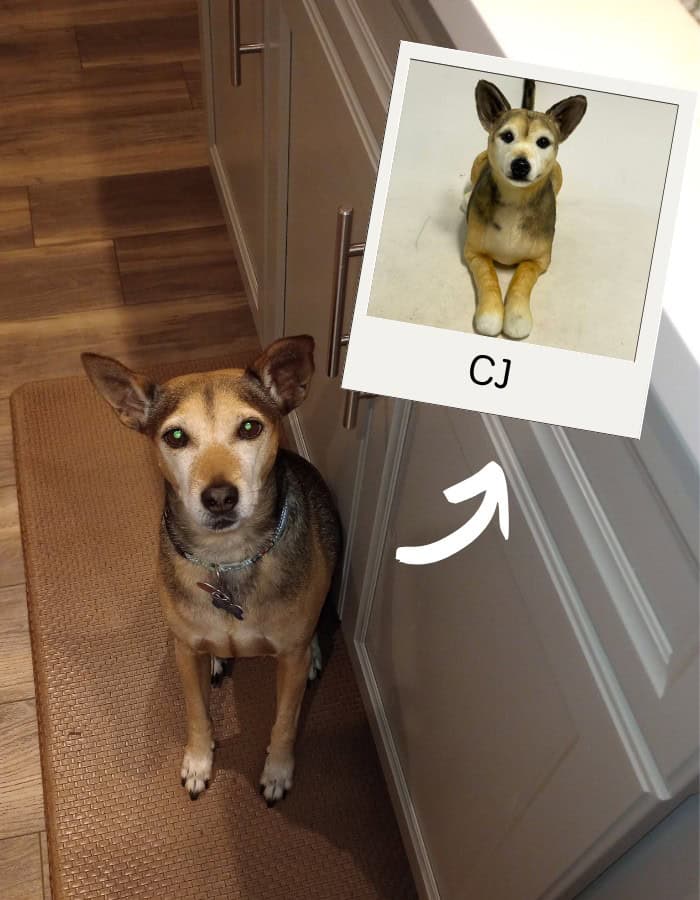
Through all of it, Bob has always found comfort in one constant: his dog, CJ. His wife brought CJ to visit every single day, and soon, every resident and staff member in the facility knew and loved him. When CJ passed away suddenly, the loss was felt throughout the entire community, but for Bob, it was truly devastating. He began asking for CJ daily, his nights became restless, and his entire demeanor changed as he struggled to process the absence of his best friend.
A Gift of Peace
A family friend reached out to us, hoping a custom plush likeness of CJ might bring some peace. It felt like a small gesture, but it would become a massive gift of comfort for Bob.
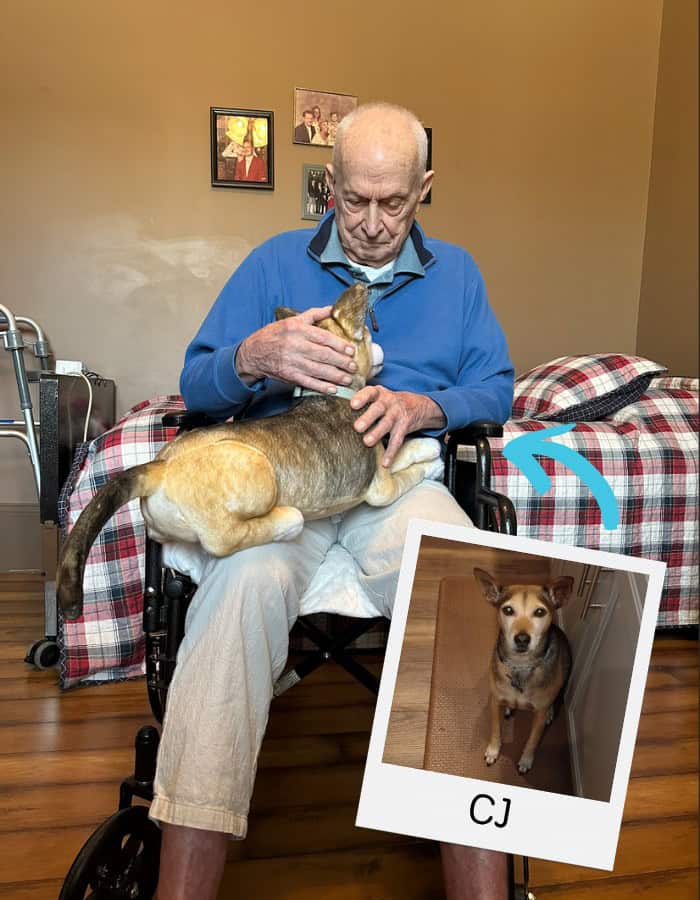
The moment Bob saw his Petsie for the first time, he lit up. He immediately said, “There’s my boy,” gently patting the stuffed animal like he’d just been reunited with his best friend.
The impact was immediate: The first night Bob had the plush CJ, he slept through the night, something his family said hadn’t happened since CJ passed.
The Science of Comfort: Why it Works
While Bob’s story is a touching example of the bond between a human and a pet, his experience is also supported by a growing body of scientific research. Experts in geriatric care and psychology have found that for seniors living with cognitive decline, the presence of a familiar “comfort object” is a powerful tool for emotional regulation.
1. Connecting Through Touch and Memory Research published in Innovation in Aging highlights “object handling” as a key psychosocial intervention. When short-term memory fails, the sensory experience of touch, feeling the soft fur of a familiar-looking pet—can activate deep-seated emotional memories. This provides what researchers call “multisensory representations,” helping seniors feel more grounded in their environment even when they are confused or anxious (D’Andrea et al., 2022).
2. Bridging the Gap of Loss The loss of a companion animal can cause grief as severe as the loss of a human family member, which is often compounded for those in memory care. A study in Death Studies explores the concept of “continuing bonds”, the healthy practice of maintaining a symbolic connection with a deceased loved one. For Bob, his Petsie served as a physical bridge for that bond, allowing him to maintain his role as a caregiver and friend to CJ, which significantly reduced his distress and restlessness (Lykins et al., 2023).
3. Real Results in Daily Life Low-cost, realistic companion keepsakes have been shown to improve mood, reduce social isolation, and decrease agitation in residential care settings. Clinical reviews have noted that these familiar objects can lead to better sleep patterns and increased verbal interaction with staff and family, mirroring exactly what Bob’s family witnessed during his first night with his custom plush (Koh et al., 2021).
By providing a tangible connection to a lifetime of love, these keepsakes do more than fill a space on a shelf, they provide a sense of security that the brain recognizes, even when the memory of “today” has faded.
Order Your Own Custom Plush Today!
Resources
- D’Andrea, F., Dening, T., & Tischler, V. (2022). Object Handling for People With Dementia: A Scoping Review and the Development of Intervention Guidance. Innovation in Aging, 6(5). https://pmc.ncbi.nlm.nih.gov/articles/PMC9331071/
- Koh, W. Q., Ang, F. X. H., & Casey, D. (2021). Impacts of Low-cost Robotic Pets for Older Adults and People With Dementia: Scoping Review. JMIR Rehabilitation and Assistive Technologies, 8(1). https://pmc.ncbi.nlm.nih.gov/articles/PMC8082946/
- Lykins, A. D., McGreevy, P. D., Bennett, B., Paul, N. K., & Gotsis, N. (2023). Attachment styles, continuing bonds, and grief following companion animal death. Death Studies, 48(7), 698-705. https://doi.org/10.1080/07481187.2023.2265868